by Martin Treiber and Arne Kesting
This textbook offers a comprehensive and clearly structured introduction to vehicular traffic flow dynamics and modeling. It explores key empirical phenomena such as stop‑and‑go waves, presents detailed models of driver behavior, and introduces essential methods for stability analysis. With its clear explanations and intuitive approach, the book provides an ideal entry point for students of engineering, physics, and mathematics. Unlike previous literature, which covered this interdisciplinary field primarily through specialized monographs, this volume opens the subject to a wider readership. Numerous illustrative figures and end‑of‑chapter problems —with solutions— help readers quickly internalize and apply the concepts.
The new edition of this well-received textbook has been thoroughly updated and expanded. It now includes new chapters on pedestrian dynamics, non-lane-based and mixed traffic, dynamic navigation, map matching, and routing oscillations. Additional sections cover the complete specification of the Wiedemann models, the piecewise linear model, IDM+, as well as advanced topics like lane changing, multi-anticipation stability, hybrid and electric mobility, and fuel consumption modeling.
This comprehensive and accessible textbook explores the dynamics and modeling of pedestrian and vehicular traffic flow. Previously documented only in specialized monographs, this interdisciplinary subject is now presented in a unified and reader-friendly format. Numerous figures and exercises with solutions support quick understanding and hands-on practice. The book is ideal for students in physics, traffic engineering, computer science, mathematics, and related interdisciplinary fields. It also serves as a valuable resource for professionals and offers material suitable for programming and simulation projects at the college and university level.
Beginning with an overview of various traffic data types, the book delves into mathematical models of traffic flow, covering both macroscopic (density-based) and microscopic (vehicle-level) approaches. Dedicated chapters discuss traffic instabilities, model calibration, and practical applications such as travel-time estimation, intelligent transportation systems (ITS), and emissions modeling.
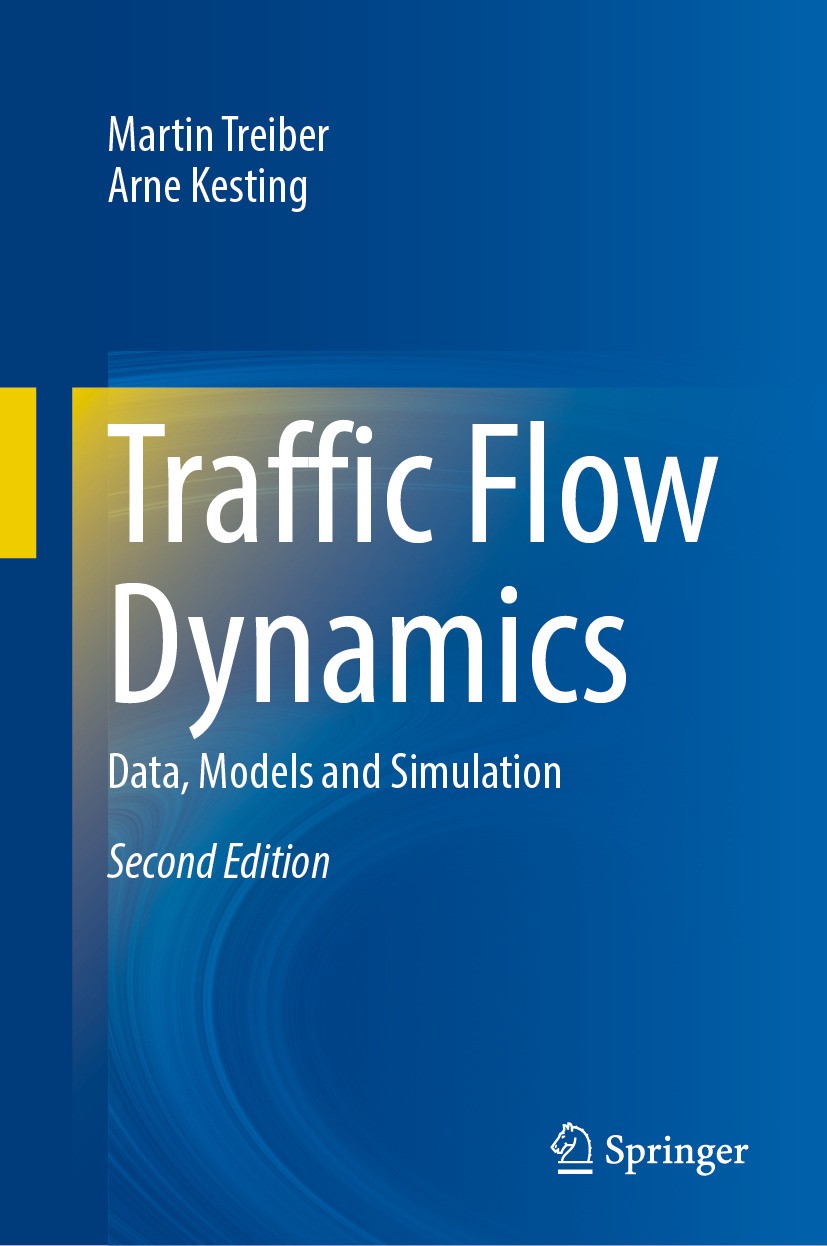
Second Edition: ISBN 978-3-031-93922-8 · 2025, 781+XXVI pages, 17 b/w illustrations, 277 in color.
Springer's Booksite · Hard Cover (Amazon) · Altmetrics
First Edition: ISBN 978-3-642-32460-4 · 2013, 503 pages, 194 illustrations, 54 in color.
Take a look at the Table of Contents and two free sample chapters in PDF format. The Chapter 11 describing Car-Following Models Based on Driving Strategies is a good starting point to learn about microscopic traffic models, particularly the Intelligent Driver Model (IDM) and some enhancements.
Table of Contents (PDF) · Chapter 2 (PDF) · Chapter 11 (PDF)We appreciate your feedback and maintain an up‑to‑date list of errors and typos here.
Errata (2nd edition, 2025) · Errata (1st edition, 2013)
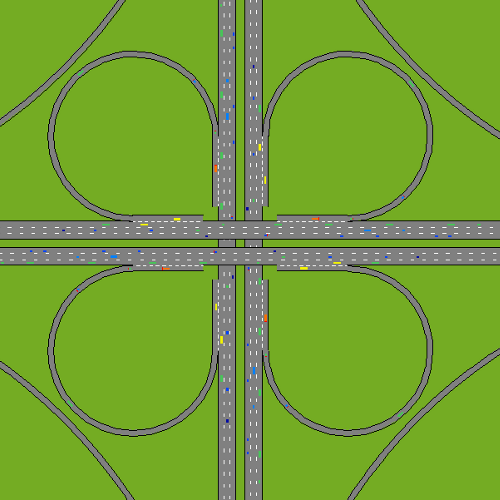
The open-source simulator is written in Java and implements various car-following models. MovSim provides reference implementations for the models described in this textbook as well as some simulation scenarios. The source code is available on Github.
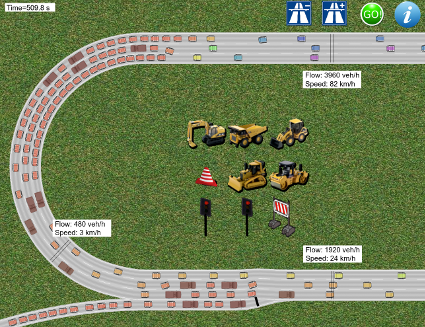
The open-source simulator is written in JavaScript and demonstrates the principles of traffic flow dynamics in different scenarios. Parameters can be varied interactively in order to experience their effects. Check out the video on YouTube or the summary documentation for more information – or try it out directly.
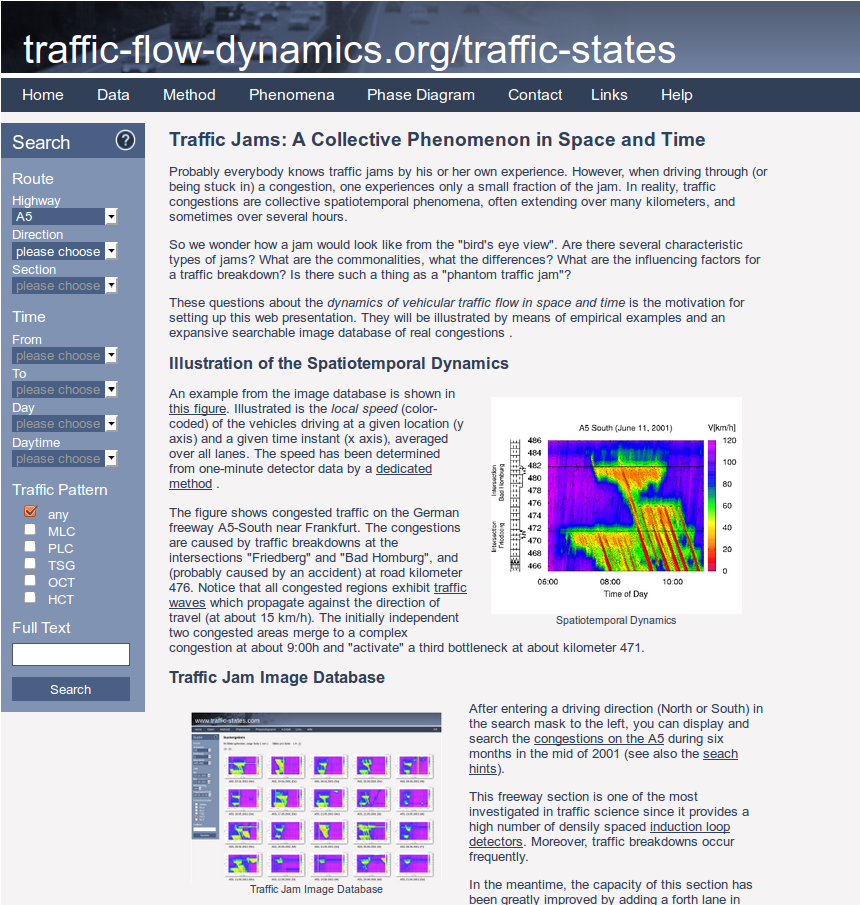
The website illustrates the rich dynamics in space and time of traffic flow by means of empirical data. The website offers a searchable image database of real congestion patterns. It explains the different characteristic types of traffic jams, the influencing factors for a traffic breakdown and if there is such a thing as a phantom traffic jam.